
Read the Formula, Not the Language
Article by Rootmere. Offered to FEEFHS, free and unconditionally, for publication (dated October 2026).
The single question we are asked most often is some version of this: "The records are in Russian" — or German, or Latin — "and I don't read it. Do I have to hire a translator for every page?"
Almost always, no. And the reason is the thing this article is about: a nineteenth-century vital record is not a piece of free prose. It is a form filled out loud. The clerk or priest wrote the same sentence for every birth, every marriage, every death, with only the names, dates, ages and places changing. Learn the sentence once and you can read ninety percent of any register that never changes, in a language you do not speak.
What follows is how we teach ourselves a new register, and where the method honestly breaks down.
Why the entries are boilerplate
These were legal documents produced in bulk by officials who had better things to do than vary their phrasing. A parish priest might write forty baptisms in a month; a Prussian registrar, hundreds of civil entries a year. Repetition was the whole point. The state wanted every entry to contain the same facts in the same order so that a clerk in another office, years later, could find them.
That bureaucratic laziness is the family historian's best friend. It means the structure carries the meaning. Once you know that a Russian-language Catholic birth record from the Kingdom of Poland opens by naming the place, the date in words, and then the father with his age and occupation, you already know what the first three lines say before you have read a single word of Russian.
A worked example: the Kingdom of Poland after 1868
From 1868, Russian authorities required Catholic parish registers in the Kingdom of Poland to be kept in Russian. For a family that spoke Polish and worshipped in Latin, the entry about them was suddenly written in Cyrillic, by a priest who was himself working from a template. The template is rigid, and it is worth memorizing, because it covers an enormous number of American families whose ancestors left exactly this region between 1890 and 1914.
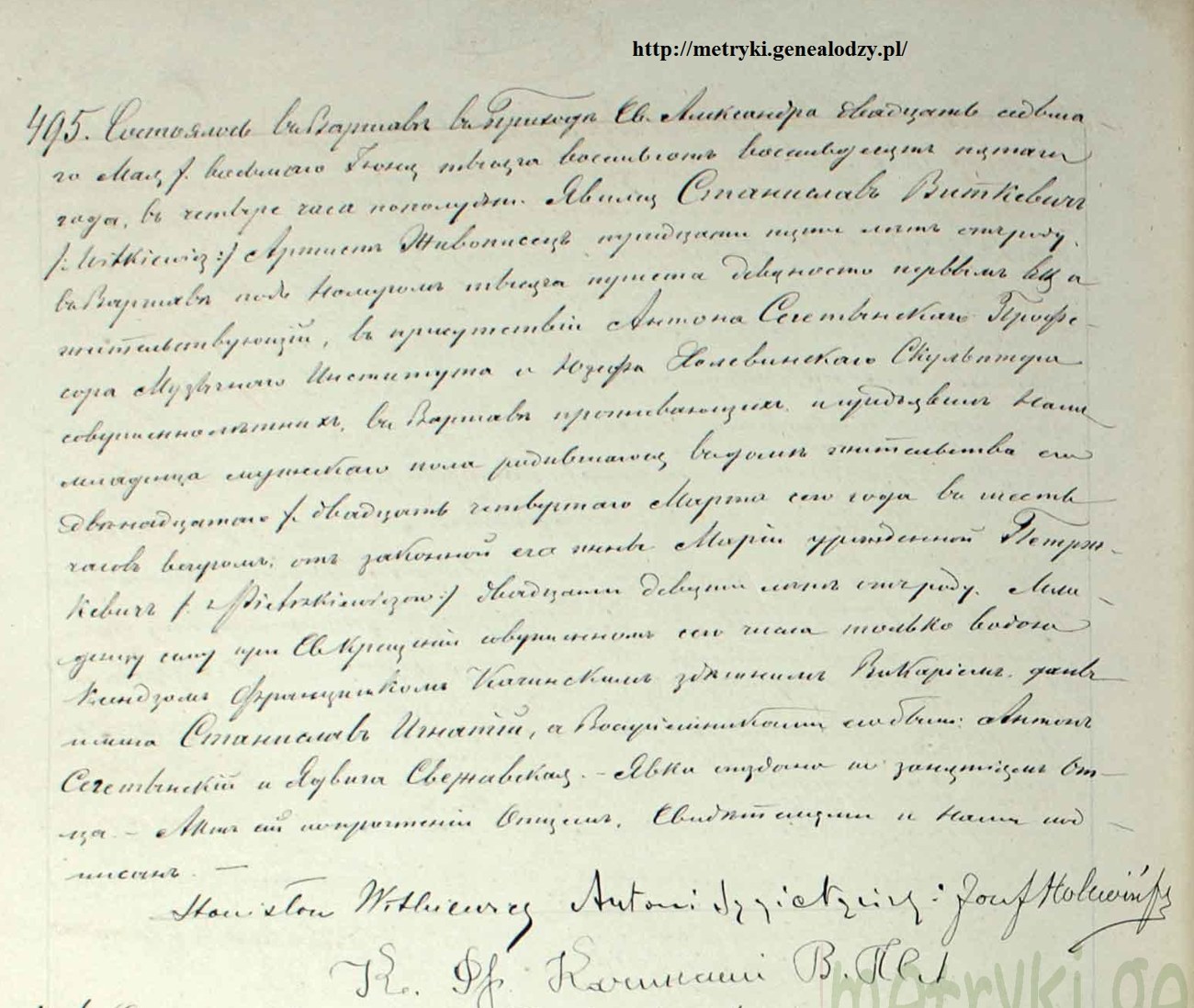
Image 1. A Russian-language Catholic birth record, Warsaw, parish of St. Aleksander, 1885 (the baptism of Stanisław Ignacy Witkiewicz). The entry opens exactly as the formula below predicts: "Состоялось въ Варшавѣ въ Приходѣ Св. Александра…" — "It happened in Warsaw in the parish of St. Aleksander…" Source: metryki.genealodzy.pl via Wikimedia Commons, public domain.
The birth formula runs, in order:
Slot What it always says The variable
Place and time "It happened in [village] on [day] of [month], [year], at [hour]" village, date, hour
Who presented the child "there appeared [name], [occupation], [age] years old, resident of [place]" the father
Witnesses "in the presence of [name], [age], and [name], [age]" two witnesses
The child "and showed us a child of the [male/female] sex, born in [place] on [date] at [hour]" sex, place, date
The mother "of his wife [name] née [surname], [age] years old" mother's maiden name
Baptism "at holy baptism performed today the child was given the name [name]" the child's name
Godparents "and the godparents were [name] and [name]" godparents
Everything in the middle column is the same in every entry in the book. You are reading for the right-hand column only. Thirty or so recurring words — happened, appeared, wife, née, godparents, years old, the twelve months, and the numbers one through thirty-one — unlock the entire register. Not Russian. Thirty words of Russian.
The numbers are half the battle
Most of what a researcher actually needs from a vital record is numeric: the day, the month, the year, the ages. In handwritten Cyrillic, and in Kurrent, the words for numbers are the hardest part to read cold and the easiest to learn deliberately, because there are so few of them. We tell people to make a single reference sheet of the numbers one to thirty-one and the twelve months in the script of their register, and to keep it beside them. After a dozen entries they stop needing it.
A second example: Prussian civil registration after 1874
When Prussia introduced civil registration in October 1874, every birth, marriage and death in the eastern provinces began to be recorded twice: once in the Standesamt register and once in a duplicate. The earliest of these are written in Kurrent, the German handwriting of the period, and they are even more formulaic than the parish books, because the registrar filled names and dates into a sentence that was fixed by law. By the early twentieth century the scaffold was often a pre-printed form, which makes the point visible at a glance.
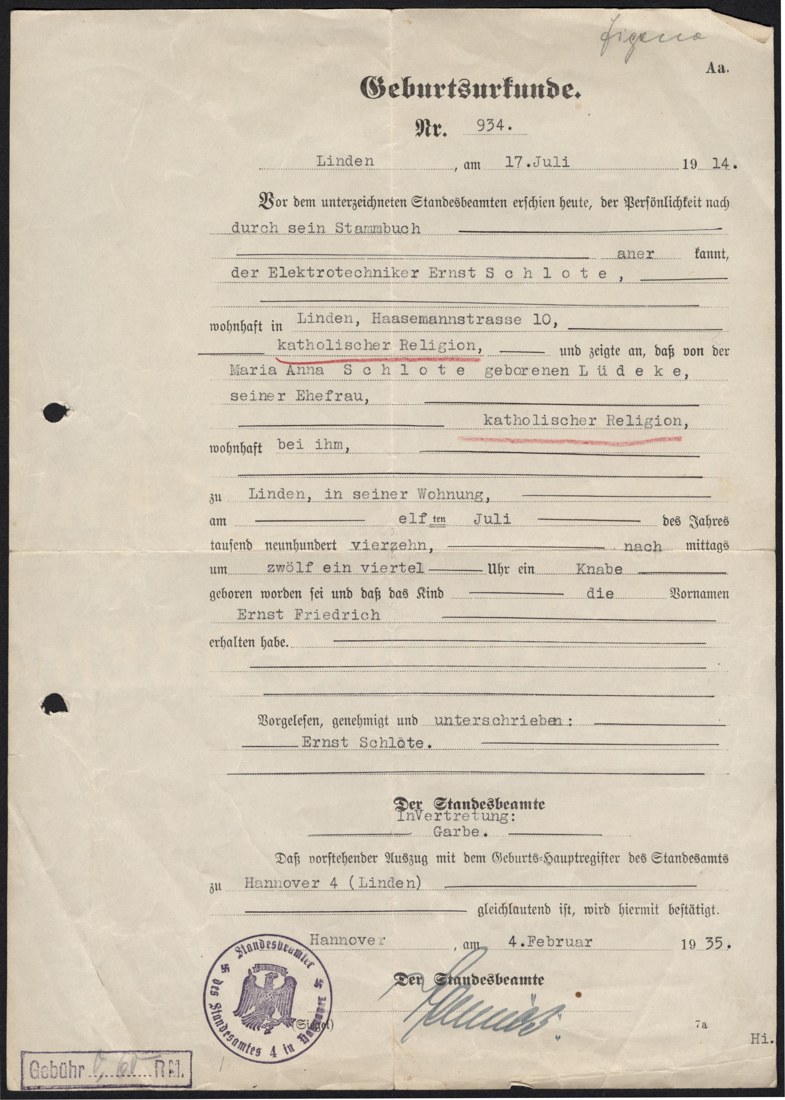
Image 2. A Standesamt birth certificate (Linden, near Hannover, 1914). Everything in bold type is the pre-printed formula; only the entries written into the blanks — the registrar's name, the father, the mother, the date, the child's names — carry the facts. Source: Wikimedia Commons, released CC0.
Here the formula is literally printed on the page. "Vor dem unterzeichneten Standesbeamten erschien heute, der Persönlichkeit nach … anerkannt…" — "Before the undersigned registrar there appeared today, identity … established…" — is typeset. The researcher's eye can skip every printed word and land only on the filled-in slots. In the handwritten registers of the 1870s and 1880s the same sentence is there in Kurrent rather than in type, but it is just as fixed; once you recognize its shape, the script is the only obstacle left, and the script is confined to a handful of words per entry.
Where the method fails
We would be doing a disservice to pretend the formula is everything. It is not, and the places it breaks are exactly the places a careful researcher must slow down and, sometimes, ask for help.
Marriage entries are the main exception. A straightforward marriage follows a template as rigid as a birth. But the moment there is anything unusual — a dispensation for consanguinity, a previous spouse, a legal impediment, a note about banns read in another parish — the clerk leaves the formula and writes real prose. That prose is where the most valuable genealogical detail often hides, and it is where knowing the language, not just the formula, finally matters.
The second trap is the margin. Priests and registrars added later notes — a death cross-referenced to a baptism, a legitimation, a correction — in the margin, in their own hand, often decades later and in whatever abbreviation they pleased. Marginalia obey no template. When a marginal note exists, read it or have it read; it frequently changes the conclusion.
And the formula tells you what the record says, not whether it is true. Ages are routinely wrong, places of origin are approximations, and a priest copying from memory could err. The formula gets you reading. Judgement keeps you honest.
In short
You do not learn Russian, or German, or Latin to use these registers. You learn the sentence the register repeats, you build a one-page sheet of its thirty recurring words and its numbers, and you read for the slots. Then you slow down for marriages with complications and for anything written in the margin, because that is where the formula ends and the language begins.
This article was written by Rootmere, a team that reads and retrieves the handwritten parish and civil registers of Central and Eastern Europe. It is offered to FEEFHS free of charge and without condition; use, edit or trim it as suits your site. More on how we work is at Rootmere.